

Where Rivers, Forests, and Living Traditions Endure
In Kalimantan, rivers are more than waterways—they are lifelines. Flowing through ancient rainforests, they have carried people, traditions, and stories across generations. Along the Mahakam River lives one of Indonesia's rarest treasures, the Pesut Mahakam, a freshwater dolphin whose presence has long symbolized the river and the harmony between humans and nature.
Among these waters lives the Pesut Mahakam, Indonesia's endemic freshwater dolphin. For generations, its presence has symbolized the health of the river and the delicate balance between humans and nature. To the people of Kalimantan, the Pesut is far more than a rare species; it is a reminder that prosperity flows only when rivers are protected, forests are respected, and every living being shares the same home with mutual care.
This understanding is deeply rooted in the philosophy of the Dayak people. Through the principle of Belom Bahadat, life is guided by honor, mutual respect, communal responsibility, and reverence for both ancestors and nature. Forests are not simply resources to be consumed, rivers are not merely routes to travel, and the Lamin longhouse is more than architecture—it is where stories, customs, and values are passed from one generation to the next. In this worldview, harmony is achieved not only between people and nature, but also with the Creator and the wider community. It is this balance that allows culture to remain alive, not as history, but as everyday practice.
These values continue to be expressed through the rich visual language of Dayak artistry. The Aso motif, a mythical guardian creature, symbolizes protection, strength, and spiritual resilience. The graceful Pakis motif reflects growth, renewal, and the continuity of life, while ornaments inspired by the Mandau represent honor, courage, and responsibility. More than decorative elements, these motifs embody collective memory and ancestral wisdom. Every carving, every woven pattern, and every symbol serves as a quiet reminder of the values that continue to shape Dayak identity today.
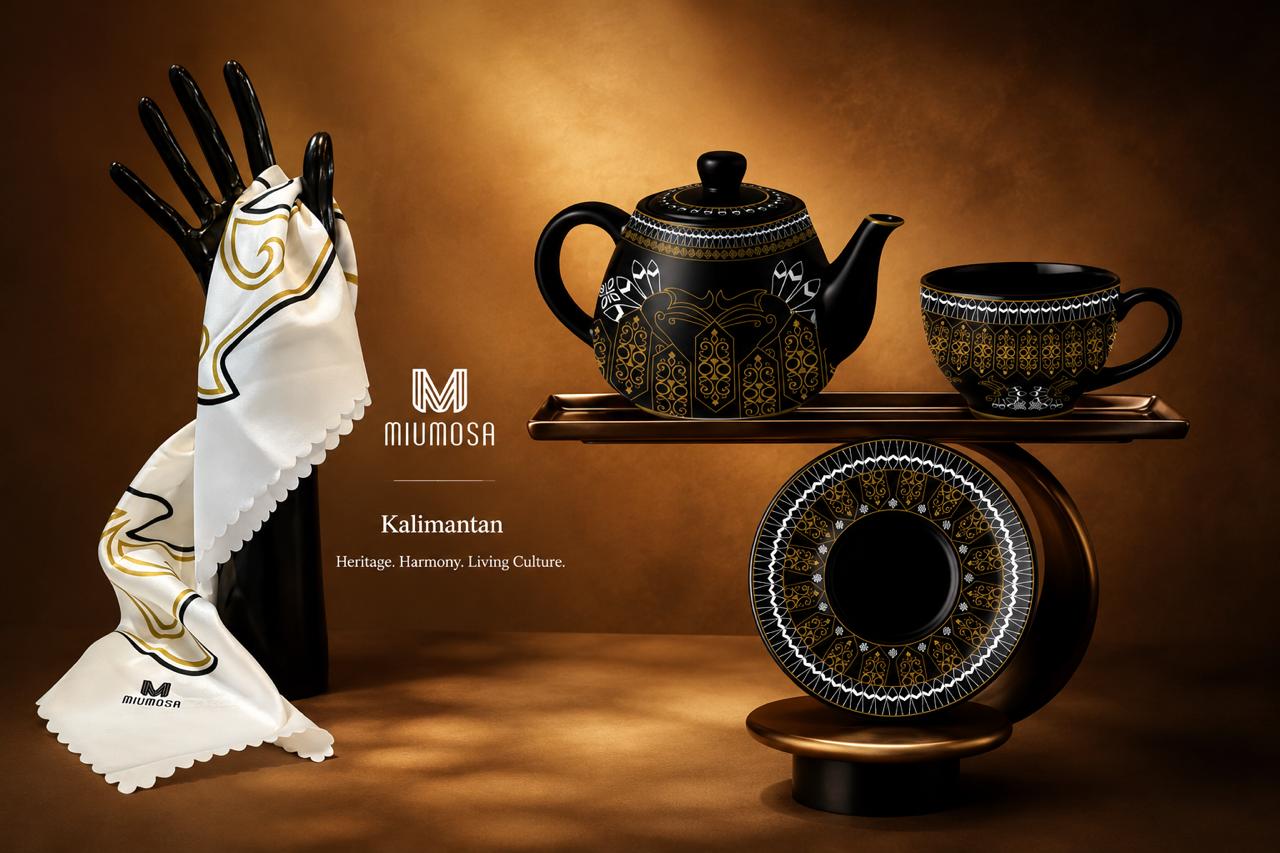
At Miumosa, we believe that heritage continues to thrive when it becomes part of everyday life. Inspired by the enduring spirit of Kalimantan, we present the Budaya Silk Scarf: Kalimantan Edition and Prajna: Pouring Culture – Kalimantan Edition—two contemporary interpretations of the same cultural narrative.
The Budaya Silk Scarf, crafted in luxurious silk twill and silk satin, celebrates the intricate beauty of Dayak motifs through fabrics chosen for their soft touch, elegant drape, and ability to reveal every detail with remarkable clarity. Complementing the scarf, the Prajna tea set—consisting of a teapot, two cups, and two saucers—brings these cultural narratives into moments of everyday gathering. Every cup poured becomes an invitation to pause, connect, and appreciate the stories carried within each motif.
Rather than redefining these cultural symbols, the collection seeks to honor them. It invites Indonesian heritage to remain present in contemporary living—not only as objects to admire, but as traditions to wear, rituals to share, and stories to pass on.
---
A Visual Lexicon
Each motif in this collection reflects a layer of Kalimantan's cultural landscape. Drawn from nature, tradition, and the visual heritage of the Dayak people, these elements are reinterpreted with care—preserving their essence while finding a place within contemporary design.
-
Pesut Mahakam. Rendered in fine linework, the Pesut Mahakam motif is interwoven with the Tengkawang pattern to evoke the quiet movement of the Mahakam River. Endemic to these waters, the freshwater dolphin has long been regarded as a symbol of the delicate relationship between people and the river that sustains them.
-
Talawang. Derived from the traditional Talawang shield of the Dayak people, this motif represents protection. Within the composition, it serves as a symbolic guardian of the Pesut Mahakam, reflecting a shared responsibility to safeguard both cultural heritage and the natural world.
-
Tengkawang Ampiek. Named after the Tengkawang tree and Ampiek, meaning carving in the Kutai language, this motif draws from East Kalimantan's ornamental traditions. Long associated with the abundance of the forest and the continuity of life, it occupies the heart of the composition, where it is subtly reinterpreted through Miumosa's signature monogram.
-
Kawung Monogram. The Kawung motif is reimagined through the Miumosa monogram as a unifying element throughout the scarf. Its measured geometry introduces a sense of rhythm and balance, complementing the organic forms inspired by Kalimantan's rivers and forests.


